Home < News < Bridge Bearing Manufacturer Explains: Bridge Spherical Bearing vs. Bridge Pot Bearing – What's the Difference?
Bridge Bearing Manufacturer Explains: Bridge Spherical Bearing vs. Bridge Pot Bearing – What's the Difference?
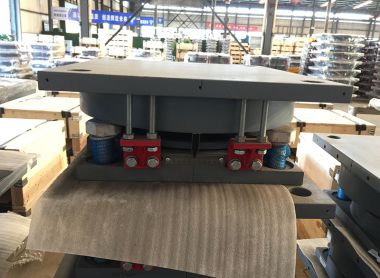
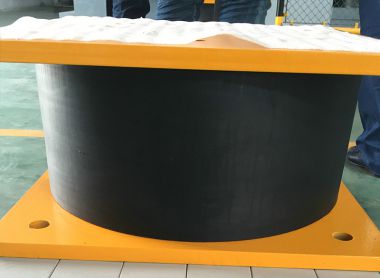
The main difference between a bridge spherical bearing and a bridge pot bearing is their structure. This affects how they carry loads and handle movement.A **bridge spherical bearing** uses a spherical sliding surface. It has an upper bearing plate, a lower bearing plate, a spherical sliding plate, a flat sliding plate, and a dust cover. The bottom of the upper plate is a convex sphere. It fits into the concave sphere on the lower plate. This allows the bearing to rotate in many directions. The flat sliding plate allows horizontal movement. The sliding plates are often made of PTFE and stainless steel. The friction coefficient is as low as 0.03, so sliding is easy. The rotation angle can reach up to ±0.05 rad. Horizontal displacement can be customized. For large models, it can reach ±200 mm.A **bridge pot bearing** uses a steel pot and rubber to carry loads. It has an upper bearing plate, a lower bearing plate, a rubber plate, a steel pot, a sealing ring, and a guiding device. The steel pot is made by forging. A circular rubber plate sits inside the pot. Vertical loads are transferred by compressing the rubber. Small rotation comes from the rubber's shear deformation. Horizontal displacement happens when the upper plate slides over the rubber and pot. Some models have a guide block to limit sideways movement. The rubber is made of chloroprene or natural rubber. Its Shore hardness is 60–70. It has good elastic recovery and aging resistance.

The key performance differences between a bridge spherical bearing and a bridge pot bearing are in load capacity, deformation, and seismic performance.**Load capacity** – Both can carry large loads, but they fit different needs. A bridge spherical bearing spreads the load evenly over its spherical surface. Its vertical load range is very wide. Standard models can carry 1,000 to 50,000 kN. They can also take horizontal loads and overturning moments. They are good for long-span steel box girders and continuous rigid-frame bridges. A bridge pot bearing has a vertical load capacity of 500 to 30,000 kN. The rubber plate absorbs load impact and reduces vibration. This makes it good for small and medium-span concrete bridges.**Deformation** – A bridge spherical bearing has clear advantages. Its spherical structure allows rotation in any direction without extra stress. It can adapt to complex deformations caused by temperature changes and loads in long-span bridges. It is especially good for curved bridges, cable-stayed bridges, and suspension bridges. A bridge pot bearing has a smaller rotation angle, usually ±0.02 to 0.03 rad. It may cause local stress during rotation. It is more suitable for straight bridges and small to medium-span continuous girder bridges. For horizontal movement, a bridge spherical bearing allows free movement in two directions. A bridge pot bearing needs different designs for one-way or two-way movement, so it is less flexible.**Seismic performance** – Their design logic is different. A bridge spherical bearing can be fitted with seismic damping devices. The spherical surface and damping material create friction that absorbs earthquake energy. Its ability to move in all directions helps it handle multi-dimensional shaking. It is widely used in high-intensity seismic areas (magnitude 8 and above). A bridge pot bearing relies on the rubber plate to absorb earthquake energy. But its horizontal shear resistance is weak. In high-intensity areas, extra devices are needed to prevent pullout and damage. Otherwise, the rubber may break or the bearing may come off..
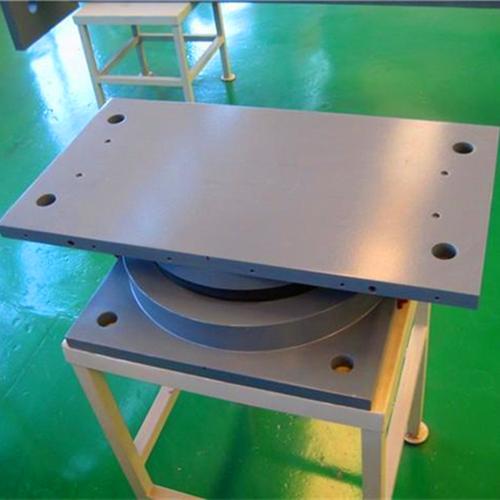
The manufacturing process and materials also affect the quality and service life of bridge spherical bearings and bridge pot bearings.**Bridge spherical bearings** need very high machining accuracy. The spherical curvature of the upper and lower plates must be machined by CNC equipment. The error is within ±0.05 mm. The sliding plate is made by high-temperature pressing and composite molding to ensure a uniform friction coefficient. The steel is often Q355B or Q460 high-strength steel. The surface is treated by hot-dip galvanizing or arc spraying. The corrosion protection level reaches C5. The service life is generally over 50 years.**Bridge pot bearings** focus on steel pot forging and rubber vulcanization. The steel pot must be forged and heat-treated to remove internal stress. This prevents deformation or cracking under load. The rubber plate is made by high-temperature vulcanization. This ensures tight bonding with the steel pot without bubbles. The steel parts are often Q235B or Q355B steel. The rubber plate must meet the JT/T 391 standard for highway bridges. With normal corrosion protection, the service life is about 30–40 years. In coastal high-salt environments, extra corrosion protection is needed.