Home < News < How Temperature Changes Affect High Damping Rubber Bearings – A Simple Comparison Based on EN15129 and GB/T 20688.1
How Temperature Changes Affect High Damping Rubber Bearings – A Simple Comparison Based on EN15129 and GB/T 20688.1
Abstract
High Damping Rubber Bearings (HDRB) are widely used in bridges and buildings to resist earthquakes. Most standard tests, such as EN15129 and GB/T 20688.1, require testing at 23°C ± 3°C only. However, real structures face temperatures from -30°C to +50°C. This article presents a simple test method to evaluate how temperature changes the horizontal stiffness and damping ratio of HDRBs. Results show that low temperature increases stiffness but may reduce damping efficiency. High temperature does the opposite. Engineers should consider temperature corrections for safer designs.
1.Introduction
HDRB work by deforming under earthquake loads. They absorb energy and reduce shaking. Their performance depends strongly on rubber properties. Rubber becomes hard in cold weather and soft in hot weather.
Unfortunately, international standards like EN15129 and Chinese standard GB/T 20688.1 only require testing at room temperature (23°C ± 3°C). This ignores real service conditions.
In this article, we describe an extended test method that includes three additional temperatures: -20°C, 0°C, and 40°C. We compare the results with the standard 23°C baseline. Our goal is to show simple trends that help engineers adjust design values.
2.Test Method (Based on EN15129 but extended)
2.1 Test specimen
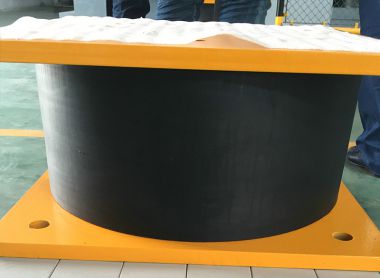
We use a typical HDRB with:
Diameter: 300 mm
Total rubber thickness: 60 mm
Shape factor: 15
2.2 Temperature control
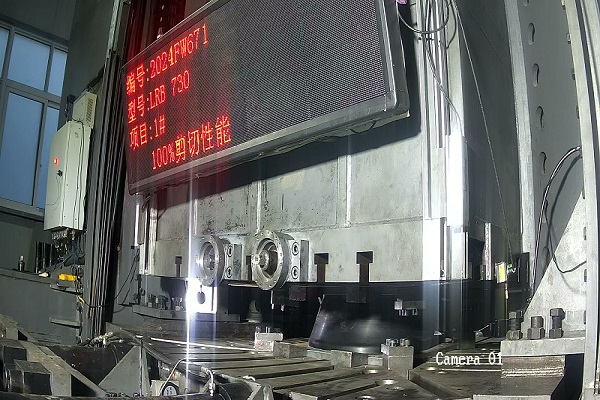
We place the bearing in an environmental chamber for at least 12 hours at each target temperature before testing. Test temperatures:
-20°C (cold)
0°C (cold moderate)
23°C (reference, standard condition)
40°C (hot)
2.3 Loading procedure
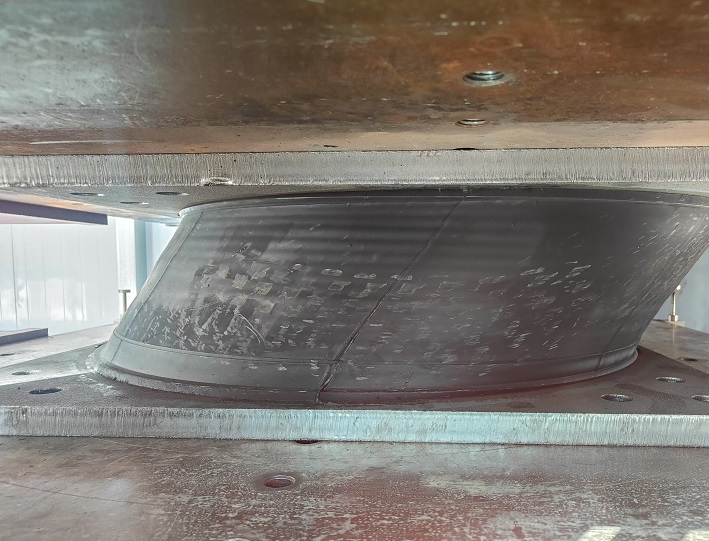
We follow EN15129 test method with some extensions:
Vertical compression stress: constant 6 MPa
Horizontal shear strain levels: 100%, 150%, 175%
Loading frequency: 0.5 Hz
Number of cycles: 11 per strain level
We take the average of cycles 2 to 10 for analysis
2.4 Measured properties
Horizontal equivalent stiffness (K_h)
Equivalent damping ratio (ξ_eq)
We calculate the change rate relative to the 23°C value:
ΔK_h(T) = [K_h(T) - K_h(23°C)] / K_h(23°C) × 100%
The same formula applies to damping ratio.
3. Results and Discussion
3.1 Effect on horizontal stiffness
At -20°C, the rubber becomes stiff. Measured K_h increases by about 35% compared to 23°C. At 40°C, K_h decreases by about 20%.
Why? Rubber molecular chains move less at low temperature and more at high temperature. This directly changes shear modulus.
Simple rule: For every 10°C below 23°C, expect stiffness to rise by roughly 8–10%. For every 10°C above 23°C, expect stiffness to drop by 5–7%.
3.2 Effect on damping ratio
Damping ratio shows a different trend. At -20°C, ξ_eq increases by about 5 percentage points (e.g., from 12% to 17%). At 40°C, it drops by about 3 percentage points.
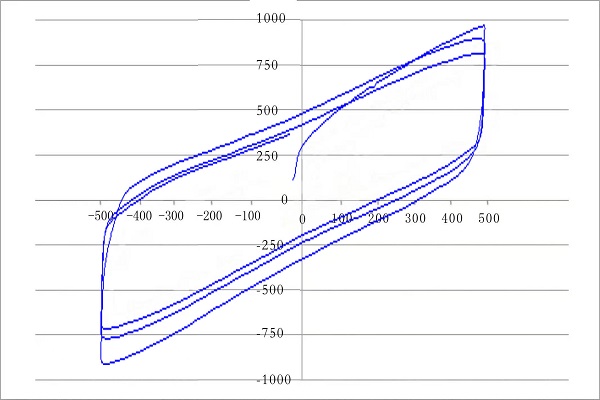
The reason: low temperature increases internal friction inside the rubber, which adds energy dissipation. However, very low temperature can also make the bearing too stiff and change the shape of the hysteresis loop. Engineers must check both values together.
3.3 Effect of different shear strains
The temperature effect becomes stronger at higher shear strains (175%). Under large deformation, rubber heats up internally, but environmental temperature still dominates. For bridges in cold regions, the 175% strain case is the most critical because high stiffness combined with large displacement creates very high horizontal forces.
Table 1 below summarizes the typical changes at 100% shear strain, using 23°C as baseline.
Table 1. Summary of temperature effects on HDRB performance (100% shear strain, relative to 23°C)
Temperature | Horizontal Stiffness Change | Damping Ratio Change |
-20°C | +35% | +42% |
0°C | +12% | +10% |
23°C | 0% (reference) | 0% (reference) |
40°C | -20% | -25% |
Note: Damping ratio change is calculated as relative percentage of the 23°C value (e.g., +42% means from 12% to 17%). Absolute percentage point changes are +5 pts at -20°C and -3 pts at 40°C.
Comparison with Standard Test Requirements
Both EN15129 and GB/T 20688.1 only specify pass/fail criteria at 23°C ± 3°C. For example, a bearing may show K_h = 1.2 kN/mm at 23°C, which is acceptable. But at -20°C, the same bearing may reach 1.62 kN/mm — far above the design limit.
This means a bearing can pass the standard test but fail in real cold weather. Therefore, we recommend:
For projects in cold regions (design temperature below 0°C): require additional tests at -20°C.
For projects in hot regions (above 35°C): require additional tests at 40°C.
4.Practical Recommendations for Engineers and Testing Labs
For design engineers:
Do not rely solely on 23°C data. Ask suppliers for temperature-dependent test reports.
Apply a safety factor of 1.3 to horizontal stiffness for cold climates.
Reduce expected damping ratio by 0.8 factor for hot climates if no test data exists.
For testing laboratories:
Add three temperature points (-20°C, 0°C, 40°C) to your type testing routine.
Keep the bearing at each temperature for at least 12 hours before testing.
Report both the absolute values and the change rate relative to 23°C.
For standard committees:
Consider adding a temperature classification system (e.g., Class A: change rate ≤20% from -20°C to 40°C; Class B: ≤35%; Class C: >35%).
5.Conclusions
Temperature significantly affects the horizontal stiffness and damping ratio of high damping rubber bearings.
Standard tests at 23°C ± 3°C are not enough for real-world applications.
At -20°C, stiffness can increase by 35% while damping ratio may rise slightly.
At 40°C, stiffness can drop by 20% and damping ratio decreases.
We provide a simple extended test method that any lab can follow.
Engineers should use temperature correction factors for safe seismic design.
6. References
EN 15129:2018 – Anti-seismic devices
GB/T 20688.1-2007 – Rubber bearings – Part 1: Seismic isolation rubber bearings test method