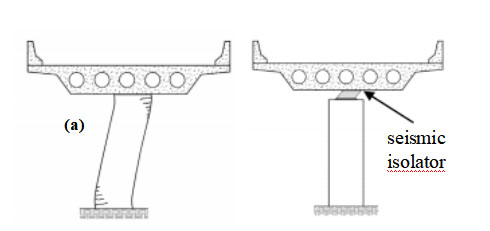
Bridge seismic isolation is a highly effective way to reduce earthquake damage. Isolation bearings are usually installed between the bridge piers and the bridge deck. They physically separate the deck from the horizontal component of ground motion, reducing the forces transferred to both piers and superstructure during an earthquake.
When an isolated bridge is hit by an earthquake, most inelastic deformation occurs in the isolation bearings rather than in the piers or deck. This helps the main structural elements remain elastic and avoids the permanent damage often seen in conventionally designed bridges.
Isolated bridges generally pursue three main goals:
1. Lengthen the fundamental period of the bridge, significantly reducing eismic forces on piers and the deck.
Dissipate energy through hysteretic damping in the isolation bearings.
Redistribute seismic forces between piers and abutments for more balanced structural response.
2. Modern bridge seismic isolation began in New Zealand in the 1970s. Today, thousands of bridges worldwide use isolation technology. In the United States alone, more than 200 bridges have adopted seismic isolation. It is now considered a cost-effective earthquake protection strategy for both new bridges and retrofit projects.
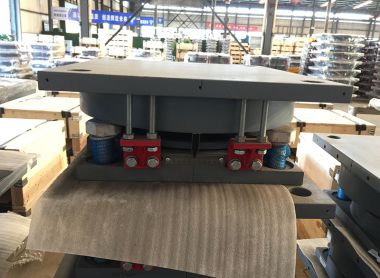
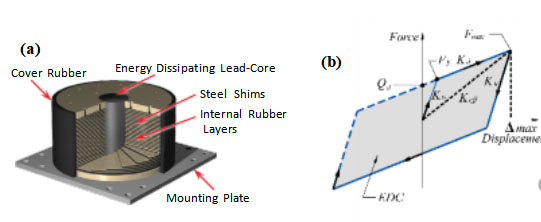
Bridge isolation bearings are generally divided into sliding bearings and elastomeric bearings. Most bridge isolation applications worldwide use elastomeric bearings, and the most common type is the lead rubber bearing (LRB).
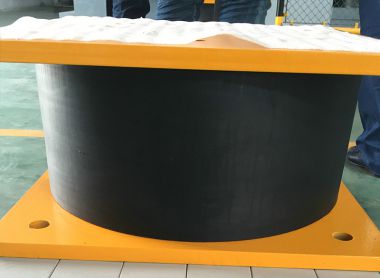
LRB (Lead Rubber Bearing): Made from low-damping natural rubber, steel shims, and a central lead core. The lead core yields under lateral displacement and dissipates seismic energy. It is one of the most researched and widely used isolation devices.
LDRB (Low-Damping Rubber Bearing): A natural rubber bearing without a lead core. It can be used alone or combined with LRBs or viscous dampers.
HDRB (High-Damping Rubber Bearing): Uses a special rubber compound to achieve high energy dissipation without a lead core. It is especially common in Japan.
A typical LRB consists of rubber layers that provide horizontal flexibility, steel shims that provide vertical stiffness, a lead core that dissipates energy, top and bottom mounting plates, and a protective rubber cover for durability. Its force–displacement behavior is bilinear, allowing it to resist service loads while performing well during strong earthquakes.
Design Codes and Trends
In the United States, bridge seismic isolation design mainly follows AASHTO’s Guide Specifications for Seismic Isolation Design (GSID-4). It covers seismic hazard analysis, design parameters, performance modification factors, and testing requirements for isolation bearings. Several state departments of transportation, including California, Oregon, and Washington, have incorporated isolation into their seismic design codes.
In China, seismic isolation and energy dissipation have been elevated to a national regulatory level. The Regulation on the Administration of Earthquake Resistance of Construction Projects (State Council Decree No. 744), effective September 1, 2021, requires that new schools, kindergartens, hospitals, elderly care facilities, child welfare institutions, emergency command centers, emergency shelters, and radio/TV buildings in high-intensity seismic zones and key earthquake monitoring areas adopt seismic isolation or energy dissipation technology. This “two zones and eight types” policy makes China one of the most proactive countries in mandating isolation for life-line buildings.
China is one of the largest markets for seismic isolation technology. Of the roughly 15,000 isolated bridges worldwide, about one-third—approximately 4,700—are in China. China also has more than 6,000 buildings using seismic isolation and about 5,500 using energy dissipation or hybrid control. Applications cover residential buildings, schools, hospitals, airports, large complex structures, bridges, and undersea tunnels.
The 2021 Regulation on the Administration of Earthquake Resistance of Construction Projects requires “two zones and eight types” of buildings to adopt isolation or energy dissipation. Several provinces, including Shandong, Gansu, Fujian, Xinjiang, and Shanxi, have issued detailed implementation rules. Shanxi required isolation for new school and hospital buildings as early as 2014.
Seismic isolation is widely used in schools and hospitals, where continuous operation after an earthquake is critical.
Tianjin Juewu School: Installed 154 friction pendulum isolation bearings, passing acceptance in one inspection.
Xixian Hospital of the Second Affiliated Hospital of Shaanxi University of Chinese Medicine: Applied full-floor isolation technology with 41 high-performance bearings.
Shihezi General Hospital and Vocational School: Used 57 friction pendulum bearings in the hospital project and 177 in a vocational education project.
Inner Mongolia Medical University Jinshan Campus: Adopted isolation bearings and dampers for hospital and student apartment buildings.
China’s first highway seismic isolation bridge was the Shijiazhuang Xinjin Bridge, built in 1998. Since then, isolation technology has been applied to more than 1,100 bridges on 21 high-speed rail lines, including Guiyang–Guangzhou, Shanghai–Kunming, Yunnan–Guangxi, and Beijing–Shanghai.
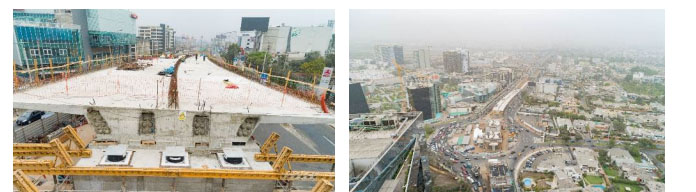
The Hong Kong–Zhuhai–Macao Bridge is a landmark example. Its location includes more than 20 meters of soft mud, which can amplify seismic waves. Lead rubber bearings between piers and deck use alternating rubber and steel layers. The rubber layers deform horizontally and dissipate more than 40% of vibration energy, while steel layers provide vertical stiffness and support about 3,000 tons. The lead core converts about 30% of seismic energy into heat. During Super Typhoon Mangkhut in 2018, the bridge displaced about 45 cm and re-centered to within 2.3 mm. It was unaffected by a 3.5-magnitude earthquake in Zhuhai in 2020.
China’s rubber seismic isolation bearing market continues to grow. In 2025, demand is expected to reach 230,000 tons, with market size up 28% year-on-year. Major suppliers include Zhongchuan Shuangrui (Luoyang) Special Equipment Co., Ltd. and Zhen’an Technology. Double spherical seismic isolation bearings have been used in the Fuzhou–Xiamen High-Speed Railway, Shenzhen–Zhongshan Link, and Huangmaohai Cross-Sea Link. They have also been exported for the Jakarta–Bandung High-Speed Railway in Indonesia and the Padma Bridge in Bangladesh, with independent verification at a San Diego laboratory in the United States.
Cost Effectiveness: The Xicali Bridge Comparison
The Xicali Bridge project in Mexicali, Mexico, compared conventional and isolated designs. With LRBs, the bridge’s fundamental period increased from 0.76 seconds to 1.83 seconds, significantly reducing lateral seismic forces.
Compared with the conventional design, the isolated design required about 3 times less concrete and 2.85 times less steel. The total foundation structure cost—including columns, foundations, and isolation devices—was about USD 2.8 million, with isolation devices accounting for about USD 940,000. The conventional design cost about USD 5.35 million, or 1.92 times more. After the 2010 Cucapah 7.2-magnitude earthquake, the Xicali Bridge performed well, with no damage and continued service.
China’s experience shows how policy, industry, and engineering practice can combine to scale seismic isolation. From the 2021 national regulation requiring isolation for schools and hospitals to mega-projects such as the Hong Kong–Zhuhai–Macao Bridge and exports for Belt and Road projects, China has become a global leader in both application scale and regulatory support.
For bridges and critical buildings in high-seismic regions, seismic isolation offers a proven combination of safety, design flexibility, and cost efficiency.
FAQ
1. What types of bridge seismic isolation bearings are available?
Common types include sliding bearings, lead rubber bearings (LRB), low-damping rubber bearings (LDRB), and high-damping rubber bearings (HDRB).
2. What is the difference between LRB and HDRB?
LRBs dissipate energy through a lead core, while HDRBs use a special high-damping rubber compound without a lead core.
3. Which buildings in China must use seismic isolation?
Under State Council Decree No. 744, new schools, kindergartens, hospitals, elderly care facilities, child welfare institutions, emergency command centers, emergency shelters, and radio/TV buildings in high-intensity seismic zones and key monitoring areas must adopt isolation or energy dissipation technology.
4. Can an isolated bridge remain usable after an earthquake?
Many case studies show that properly designed isolated bridges can remain functional after strong earthquakes, though isolation bearings and shear pins may need inspection or replacement.