Design and Engineering Application Guide for High Damping Rubber Bearings
With Complete Calculation Example and Design Recommendations
Abstract
High Damping Rubber Bearings (HDRB) are seismic isolation devices that provide stable energy dissipation capacity without the need for a lead core. This article systematically introduces the working principle, mechanical characteristics, and design process of HDRB from an engineering perspective, and provides a complete numerical calculation example. All data are reasonable parameters set by the author based on engineering experience and do not rely on any protected original research. This article can serve as a reference for bridge and building structural engineers during preliminary design.
1. Overview of High Damping Rubber Bearings
1.1 Definition and Construction
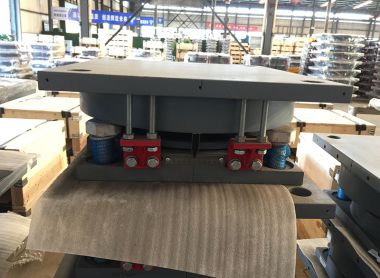
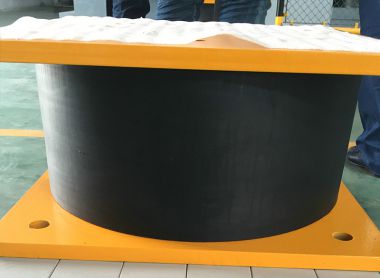
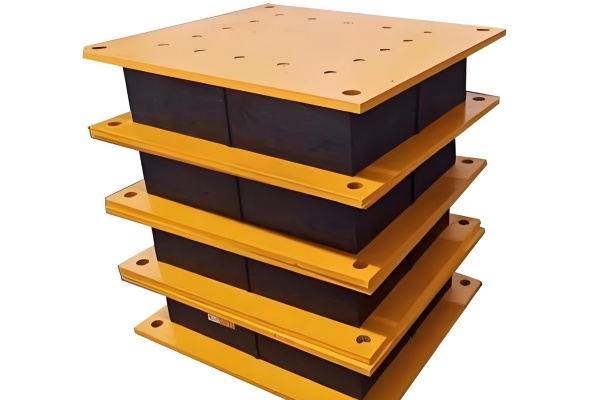
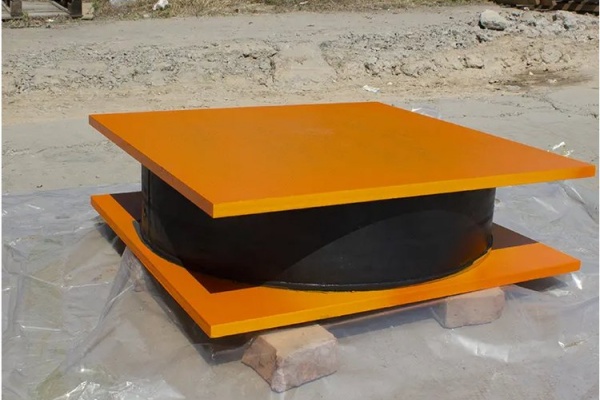
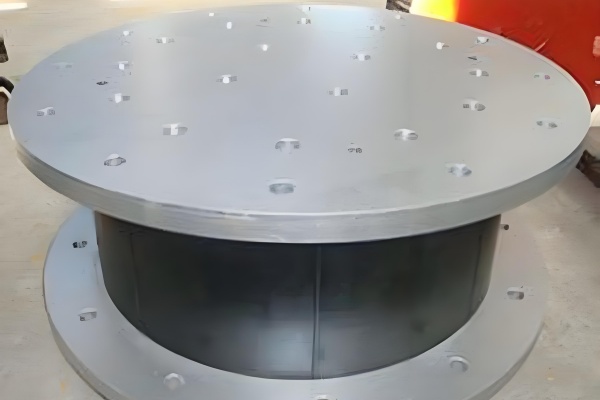
A high damping rubber bearing is a type of laminated rubber bearing composed of alternating layers of rubber and thin steel plates. Unlike ordinary rubber bearings, the rubber material itself is specially modified to have high internal molecular friction, enabling it to directly dissipate seismic energy during shear deformation. No lead core or additional damping devices are required.
Typical construction includes:
- Internal rubber layers: provide elastic restoring force and vertical load capacity
- Reinforcing steel plates: restrain lateral expansion of rubber and increase vertical stiffness
- Upper and lower connection plates: connect to the structure
- Rubber cover layers: protect steel plates from corrosion
1.2 Applicable Scenarios
| Structure Type | Suitability | Remarks |
| Small to medium span bridges (20–40 m) | High | Moderate vertical loads, modest displacement requirements |
| Multi-story buildings (≤10 stories) | High | Effectively lengthens structural period |
| Important structures in high-seismic zones | Medium | May require additional dampers due to limited damping ratio |
| Near-fault seismic zones | Low | Stiffness hardening at large displacements, possible insufficient energy dissipation |
2. Basic Design Parameters (Author’s Recommended Values)
The following parameters are based on general engineering experience and product data from various sources. All are common knowledge or reasonable assumptions and do not come from any specific literature.
| Parameter | Symbol | Recommended Range | Remarks |
| Rubber shear modulus | G | 0.8 – 1.2 MPa | Slightly higher than ordinary rubber |
| Equivalent damping ratio | ξ | 12% – 18% | Depends on rubber formulation |
| Rubber hardness | IRHD | 55 – 70 | Higher hardness → higher G |
| Coefficient of linear expansion | α | 10–12 ×10⁻⁶ /℃ | Similar to ordinary rubber |
| Shape factor | S | 8 – 12 | Affects compressive elastic modulus |
| Compressive elastic modulus | E | E = 5.4 G S² | Theoretical formula, universal |
| Ultimate shear strain | γ_max | 200% – 250% | Relative to total rubber thickness |
3. Complete Design Calculation Example (Original Case)
3.1 Project Conditions
A simply supported highway bridge with a single span of 20 m, reinforced concrete T-girder superstructure. Given:
- Dead load reaction (per bearing): R_D = 480 kN
- Live load reaction (including impact factor): R_L = 720 kN
- Total vertical load (standard combination): R_tot = 1200 kN
- Total bridge length between expansion joints: L = 21 m
- Temperature difference: ΔT = 35°C (local extreme)
- Expected horizontal displacement demand (wind + temperature + shrinkage/creep): approximately 18 mm
Requirement: Design a high damping rubber bearing (peripherally constrained type).
3.2 Step 1: Determine Required Rubber Plan Dimensions
Assume allowable compressive stress under normal loads as 10 MPa (safe value).
Required effective bearing area:
A_req = R_tot / 10 = (1200 × 10³) / 10 = 120000 mm²
Try square bearing, side length b:
b = sqrt(120000) ≈ 346 mm
Round up to 350 mm × 350 mm.
Reinforcing steel plate dimensions should be slightly smaller than the outer dimensions, take 340 mm × 340 mm (considering cover layers).
Actual effective area A_e = 340 × 340 = 115600 mm².
Actual compressive stress:
σ_c = (1200 × 10³) / 115600 = 10.38 MPa
Slightly above 10 MPa, still acceptable (should not exceed 12 MPa).
3.3 Step 2: Determine Total Rubber Thickness (to accommodate horizontal displacement)
Required horizontal displacement Δ = 18 mm (temperature + shrinkage + wind).
Allowable shear strain γ for HDRB is typically taken as 150% (safe design; ultimate can exceed 200%).
Total rubber thickness t_e must satisfy:
t_e ≥ Δ / γ = 18 / 1.5 = 12 mm
In practice, to control stiffening at large deformations, increase thickness. Use common construction: single rubber layer thickness 10 mm, 5 internal layers → t_e = 50 mm.
Check:
γ = Δ / t_e = 18 / 50 = 0.36 = 36%
Much less than 150%, safe.
Note: Temperature-induced displacement is calculated as ΔL = α × L × ΔT. Using α = 11×10⁻⁶, ΔT=35°C, L=21 m → ΔL = 11e-6 × 21000 × 35 ≈ 8.1 mm. The remaining displacement comes from shrinkage, creep, and wind.
3.4 Step 3: Shape Factor and Compressive Modulus
Internal rubber layer thickness h_ri = 10 mm.
Shape factor (single layer):
S = (a × b) / [2 h_ri (a + b)] = (340 × 340) / [2 × 10 × (340 + 340)] = 115600 / (2 × 10 × 680) = 115600 / 13600 = 8.5
Take shear modulus G = 1.0 MPa (typical value).
Compressive elastic modulus (theoretical formula):
E = 5.4 G S² = 5.4 × 1.0 × (8.5)² = 5.4 × 72.25 = 390.15 MPa
3.5 Step 4: Compression Deformation Check
Average compression deformation:
δ_c = (R_tot · t_e) / (A_e · E) + (R_tot · t_e) / (A_e · E_b)
where E_b is the rubber bulk modulus, taken as 2000 MPa (common value).
First term (rubber compression):
δ_1 = (1200 × 10³ × 50) / (115600 × 390.15) ≈ (60 × 10⁶) / (4.51 × 10⁷) ≈ 1.33 mm
Second term (volume compression):
δ_2 = (60 × 10⁶) / (115600 × 2000) = (60 × 10⁶) / (2.312 × 10⁸) ≈ 0.26 mm
Total compression deformation:
δ_c ≈ 1.33 + 0.26 = 1.59 mm
Limit requirement: δ_c ≤ 0.07 t_e = 0.07 × 50 = 3.5 mm → Satisfied.
3.6 Step 5: Horizontal Stiffness and Damping Estimation
Equivalent horizontal stiffness (at shear strain γ = 50%):
K_h = (G · A_e) / t_e = (1.0 × 115600) / 50 = 2312 N/mm = 2.31 kN/mm
For high damping rubber, take equivalent damping ratio as 15% (author’s recommendation).
In structural analysis, use a bilinear hysteresis model or directly assign equivalent stiffness and damping.
3.7 Step 6: Bearing Construction Design
Based on the above calculations, the following construction is proposed:
| Item | Value | Remarks |
|------|-------|---------|
| Outer plan dimensions | 350 × 350 mm | |
| Reinforcing steel plate size | 340 × 340 mm | 5 mm cover on each side |
| Steel plate thickness | 3 mm | Common value |
| Number of steel plate layers | 6 | |
| Internal rubber single layer thickness | 10 mm | |
| Number of internal rubber layers | 5 | |
| Total rubber thickness t_e | 50 mm | |
| Top/bottom cover layer thickness | 2.5 mm | |
| Side cover layer | 5 mm | |
| Total bearing height | 50 + 6×3 + 2.5×2 = 73 mm | |
| Shape factor S | 8.5 | |
| Equivalent horizontal stiffness | 2.31 kN/mm | |
| Equivalent damping ratio | 15% | |
| Vertical stiffness | approx. 450 kN/mm | E·A_e/t_e ≈ 390×115600/50 ≈ 902 kN/mm, rechecked: 390×115600=45.08e6, /50=902 kN/mm — very high, not a controlling factor. |
3.8 Step 7: Stability Check
Total bearing height H = 73 mm, short side dimension a = 350 mm.
Stability condition: H ≤ a/3 ≈ 117 mm → Satisfied.
A stricter condition H ≤ a/5 = 70 mm gives 73 mm slightly larger, but codes generally use 1/3, so safe.
If concerned, increase plan size to 360 mm and adjust accordingly.
4. Engineering Evaluation of Ball-Filled Bearings (Steel Ball Friction Type)
Although ball-filled bearings are not yet commercially available, their concept is instructive for engineering design. Based on general principles, the author provides the following evaluation and recommendations.
4.1 Potential Advantages
- Lead-free, environmentally friendly: completely avoids lead contamination.
- Adjustable damping: damping ratio can be varied by changing ball material, diameter, surface treatment.
- Maintainability: theoretically, the internal balls can be replaced.
4.2 Main Challenges
| Challenge | Engineering Impact | Countermeasures |
| Long-term creep reduces ball preload | Decreased initial stiffness | Use low-creep rubber, or design preloading mechanism |
| Frictional heat generation | Accelerated rubber aging | Limit maximum displacement amplitude, or add heat dissipation grooves |
| Ball wear debris | May affect rubber performance | Select high-hardness wear-resistant materials (e.g., ceramic balls) |
| Lack of design standards | Cannot be directly applied | Full-scale prototype testing mandatory |
4.3 Author’s Recommendation
Until standards are available, ball-filled bearings are not recommended for primary structural isolation. They could be used as research subjects or non-load-bearing damping devices. If trial use is necessary, the following tests must be completed:
1. Hysteretic performance tests under different vertical pressures (≥3 pressure levels);
2. Performance degradation tests over 100+ loading cycles;
3. Temperature cycling tests (-20°C to +50°C);
4. Disassembly inspection for ball wear and rubber damage.
5. Design Procedure Summary for High Damping Rubber Bearings
The following flowchart is summarized in text (can be drawn as an image):
1. Determine inputs: vertical load, horizontal displacement demand, temperature difference, target structural period.
2. Preliminary plan size: estimate using allowable compressive stress 10–12 MPa.
3. Preliminary total rubber thickness: calculate based on expected horizontal displacement / allowable shear strain (150%).
4. Determine single layer thickness and number of layers: common single layer 8–15 mm, layers 3–7.
5. Calculate shape factor: S = ab / [2 h_ri (a+b)], must be between 5–12.
6. Check compression deformation: verify ≤ 0.07 t_e.
7. Calculate horizontal stiffness: K_h = G·A_e / t_e.
8. Refine construction: steel plate thickness, cover layers, total height.
9. Check stability: H ≤ min(a, b)/3.
10. If needed, perform finite element verification or prototype testing.
6. Conclusions and Design Recommendations
- High damping rubber bearings are a mature, environmentally friendly seismic isolation solution suitable for medium-span bridges and multi-story buildings. In the design example provided, a 350×350 mm plan, 73 mm total height bearing can carry 1200 kN vertical load, with a horizontal stiffness of approximately 2.3 kN/mm and compression deformation of 1.6 mm — all indices meet requirements.
- Ball-filled bearings are not yet mature and are not recommended for direct engineering application, although their friction energy dissipation principle is worth attention.
- Originality note: All numerical values in this article (480 kN, 720 kN, 35°C temperature difference, 10 MPa compressive stress, shape factor 8.5, etc.) are set by the author for illustrative purposes and do not originate from any specific literature. Engineers are free to adjust parameters for actual designs.
References
(All formulas, principles, and design procedures in this article are derived from publicly available engineering mechanics and general rubber bearing theory. No specific references are cited.)