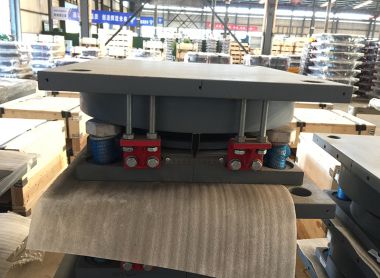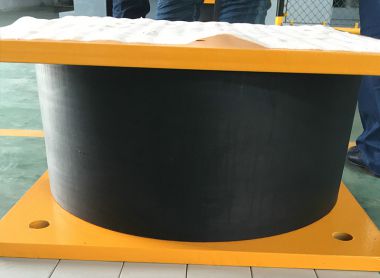
LRB seismic bridge bearings—lead rubber bearings—are small components with a large responsibility. They carry vertical loads, accommodate movement, and help control the energy and displacement that reach the bridge substructure during an earthquake. The lead core provides damping and energy dissipation, while the laminated rubber layers provide flexibility and vertical stiffness.
But a bearing that cannot be inspected after an earthquake, or replaced without major disruption, leaves the bridge’s seismic protection incomplete. This article explains how to design LRB bearings for real maintenance access: detachable covers, reserved jacking positions, lifting reinforcement, anti-fall protection and practical space for inspection and replacement.
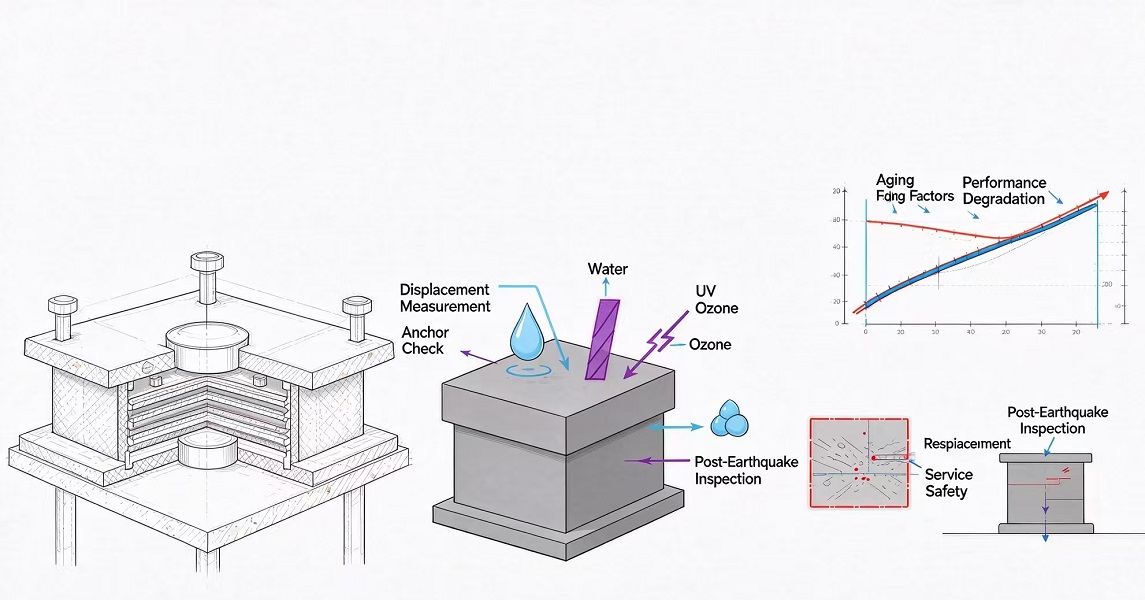
LRB bearings are expected to perform during an earthquake and to be checked immediately after it. That second requirement is often overlooked.
After a seismic event, engineers need to know whether the lead core has yielded or torn, whether the rubber layers have cracked or delaminated, whether steel plates have buckled, and whether anchor bolts have moved. If the bearing is hidden behind a fixed enclosure or surrounded by concrete, the inspection becomes an indirect exercise. Decisions about traffic reopening, temporary support or replacement are then based on assumptions rather than evidence.
Good LRB design therefore includes an inspection path. Maintenance access is not an “extra.” It is part of the bearing’s life-cycle performance.
A detachable protective cover gives inspectors direct access to the LRB. It allows them to see lead core extrusion, rubber cracking, steel plate deformation, anchor bolt movement, debris accumulation and abnormal displacement.
A fixed cover may protect the bearing from water and dust, but it can also hide the damage that matters most after an earthquake. The better approach is to treat the cover as an inspection interface:
Removable without destructive work
Reusable after inspection
Sized to allow visual access and cleaning
Designed so the bearing surface, lead core and anchor region can be reached
For LRB bearings, visibility is safety. Damage that cannot be seen cannot be managed.
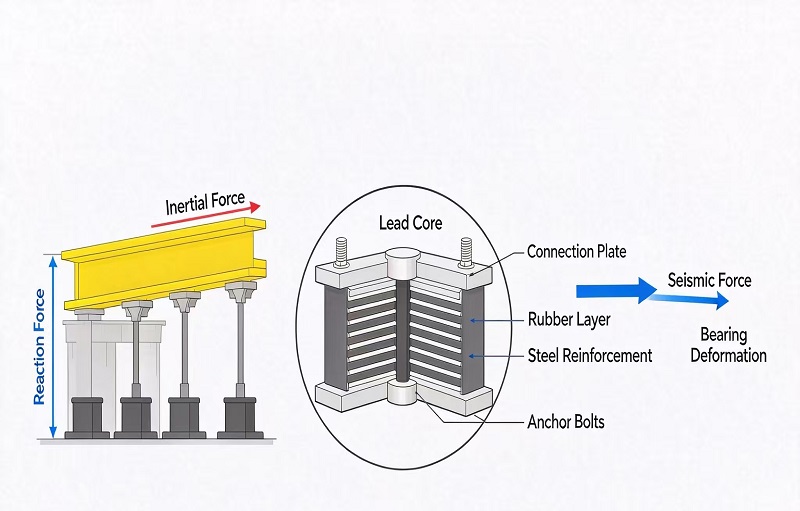
Replacement provisions are often treated as a construction detail. In seismic regions, they are a resilience decision.
An LRB designed without jacking positions forces the owner to build an external support system during an emergency or under traffic. An LRB designed with reserved lifting points turns replacement into a planned operation.
Three details matter most:
Reserved jacking positions
Provide a defined location where a jack can be placed without damaging the concrete or the bearing.
Local reinforcement for lifting
Stiffening plates or embedded reinforcement help prevent flange deformation and concrete spalling during lifting.
Operating space around the bearing
Leave enough clearance for jack placement, temporary support and lateral movement during removal and installation.
An LRB should not be boxed in by non-structural concrete or ancillary components. Replacement is not an admission of failure; it is an anticipated event that the structure should accommodate.
Seismic damage can loosen components. Anti-fall cables provide a secondary restraint so that a failed part does not become a falling hazard. The same principle applies to cables and services routed near LRB bearings: protect them from impact and falling objects.
The design logic is simple: assume that a component may become loose, and provide a backup restraint. A local failure should not escalate into a safety event.
Documented damage from the 2016 Kumamoto earthquake illustrates why inspection access matters. Rubber bearings showed side-block fracture, out-of-plane deformation and residual rotation. Some bearings had bent steel plates. In several cases, the damage was not fully understood from a single inspection angle.
For LRB bearings, the critical failure modes include lead core shear deformation, rubber layer cracking, steel plate bending and anchor bolt damage. When the bearing is enclosed or surrounded by space-occupying elements, these failure modes may remain hidden until they have progressed.
The lesson is not simply “inspect more often.” The lesson is to design an inspection geometry that lets engineers see where seismic damage begins.
Maintenance provisions buy time, but they do not answer a key question: how much capacity remains after damage?
Residual performance of LRB bearings is still an active research area. Aging tests on laminated rubber bearings show that shear stiffness and friction behavior can change over time. The lead core may also change its energy dissipation characteristics after repeated or extreme cycles. A model calibrated for a new LRB may not represent an aged or earthquake-damaged LRB without modification.
For bridge owners, this means inspection data should feed into performance evaluation. An LRB that can be inspected provides evidence. An LRB that can be replaced limits consequence. An LRB whose residual capacity is understood allows rational decisions about when intervention is truly required.
Use this checklist during design review:
Is the LRB visible and reachable for inspection?
Is the protective cover detachable and reusable?
Are jacking positions reserved and clearly marked?
Is local reinforcement provided for lifting?
Is there enough space for temporary support and LRB removal?
Are anti-fall cables or secondary restraints specified?
Are drainage and debris control detailed around the bearing?
Is there a post-earthquake inspection plan for LRB?
Are residual performance and replacement criteria defined?
LRB seismic bearing performance is not only about the bearing itself. It is also about whether engineers can inspect it after an earthquake and replace it when needed.
Detachable covers make inspection possible. Reserved jacking positions and lifting reinforcement make replacement predictable. Anti-fall cables reduce third-party risk. Together, these provisions move LRB management from reactive repair toward planned, evidence-based intervention.
For bridge owners and designers, the cost of solving these details on the drawing board is small. The cost of discovering them under a bridge deck after an earthquake is not.