1.1 Background
Bridge deck expansion joints are an important component of bridge structures. Their function is to accommodate deformation caused by thermal expansion and contraction, while also mitigating the impact of dynamic loads on the bridge structure to a certain extent. In addition, expansion joints effectively prevent deicing agents and other corrosive substances from penetrating into the substructure of the bridge, thereby avoiding damage to structural components. Typically, expansion joints are among the first components in a bridge deck system to experience damage and may require replacement multiple times over the service life of a bridge. The replacement of expansion joints is critical to extending the service life of the bridge and protecting the substructure.
Currently, the time required to replace an expansion joint typically ranges from several days to several weeks. Such maintenance operations often result in significant traffic congestion and lane closures. Therefore, it is necessary to explore technical methods that can accelerate the replacement process, particularly for bridges with high average daily traffic volumes and limited allowable lane closure windows.
In recent years, rapid bridge construction techniques have gained significant momentum and are profoundly changing traditional bridge construction methods. Rapid construction techniques focus on minimizing road closure times and often utilize prefabricated components. However, to date, there is a lack of systematic research on how to apply these techniques to the repair and replacement of expansion joints. This study was conducted to develop construction methods suitable for the rapid replacement of expansion joints.
Through a literature review, various accelerated repair methods were evaluated. Ultimately, a technical approach combining hydrodemolition, ultra-high performance concrete, and stainless steel extrusions was selected to implement this accelerated repair solution. This combination of technologies was chosen to extend the service life of the repaired joint, thereby reducing its life-cycle cost and minimizing the time required for future joint repairs.
The proposed replacement method requires a relatively high initial investment, making it necessary to evaluate its economic feasibility. A life-cycle cost analysis, combined with sensitivity studies, was conducted to compare this proposed method with current construction practices and two other alternative solutions. The analysis results indicate that for bridges with a design service life exceeding 50 years, the proposed replacement method is the most cost-effective option. For bridges with a service life of 50 years or less, a full rehabilitation at the end of the bridge's service life is a more economical approach.
This alternative joint system was tested for bond strength, static performance, and fatigue performance. During testing, hydrodemolition techniques were also employed to assess construction feasibility. The test results show that the joint system prepared using hydrodemolition can achieve excellent bonding with the existing concrete structure. The static and fatigue performance test results meet the relevant transportation department standards, indicating that the system is likely to have a long service life.
1.2 Scope of This Guide
This guide aims to detail an expansion joint replacement solution that can be used in conjunction with rapid bridge construction methods. For more information on design, construction, and testing, please refer to the final project report.
1.3 Target User Group
This guide is intended for practitioners in highway agencies, as well as engineers involved in bridge construction, safety research, and design.
Bridge Deck Expansion Joint Replacement
2.1 Components
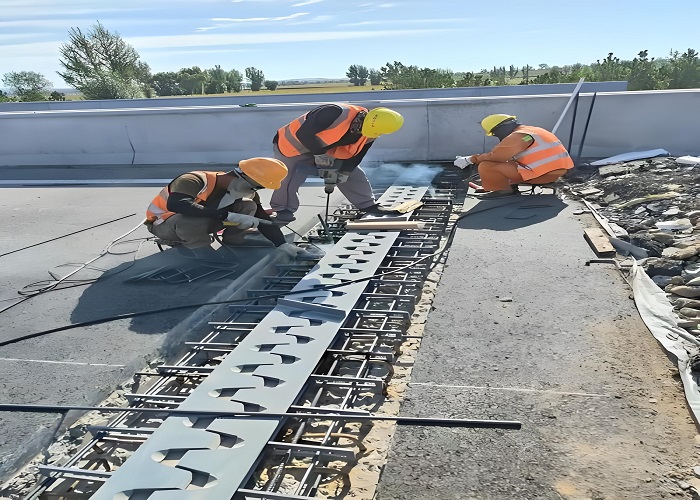
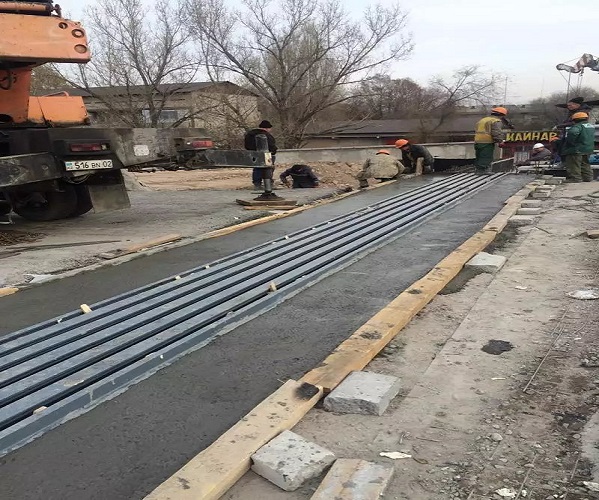
The alternative solution proposed in this study consists of multiple components that work together to maximize the efficiency of expansion joint replacement. The objectives of this solution are twofold: first, to minimize the time required for installation; and second, to maximize the service life after replacement, thereby reducing the total number of full replacements a bridge requires over its entire life cycle. Among the various types of expansion joints studied, strip seal expansion joints were highly rated by the Iowa Department of Transportation for moderate-span bridges. Furthermore, when conditions permit, strip seal expansion joints are the most commonly selected type for replacement. This type of joint consists of two steel sections embedded in the bridge abutment and deck. Subsequently, a rubber seal is installed in the gap between these steel sections. Typically, the rubber seal is the first component to deteriorate after approximately 15 years of service. These seals can be easily removed and replaced without affecting the structural integrity of the joint.
Among the various removal methods studied, hydrodemolition was selected as the optimal method due to its rapid removal speed, low labor requirements, and the excellent bonding surface it creates. Hydrodemolition is a process that uses high-pressure water jets to break down concrete. Typically, the hydrodemolition equipment is programmed and controlled by an operator located behind the equipment. This construction method effectively avoids damage to the existing reinforcement and minimizes the number of cracks generated in the remaining concrete structure.
Among the various concrete types studied for this joint component, ultra-high performance concrete was selected as the replacement material. Ultra-high performance concrete is a relatively new material, and its various application potentials are still being explored. Compared to conventional concrete, ultra-high performance concrete offers significantly improved strength and durability—its strength is approximately six times that of conventional concrete, and its durability is up to 100 times greater. Therefore, ultra-high performance concrete has an extremely long service life, potentially lasting for the entire service life of the bridge.
Beyond the individual advantages of each component, they were selected because of the enhanced benefits achieved when working together as an integrated system. The service life of stainless steel sections can match the overall service life of the bridge. Therefore, it is logical to select a concrete material with a similarly long service life. Among all the concrete materials evaluated, ultra-high performance concrete was the only one capable of matching the service life of the bridge.
For the structure composed of ultra-high performance concrete and stainless steel to last such a long time, a strong bond between them is essential to prevent premature failure. In addition to being the most efficient removal method, hydrodemolition creates the optimal bonding surface after removal, eliminating the need for subsequent sandblasting.
2.2 Considerations for Replacement Method Selection
When selecting an appropriate replacement method for a specific project, the following factors should be considered.
First, the availability of components must be considered. Before the final design phase of the project, the timely supply of stainless steel sections must be confirmed with the manufacturer.
Second, the project schedule must be considered. The curing time required for ultra-high performance concrete is longer than that of some other rapid-setting concretes (though still shorter than conventional concrete), but it can still be placed within a weekend.
Considering this, for replacement using ultra-high performance concrete and stainless steel sections, only one full replacement may be required over the remaining service life of the bridge. Spending a weekend to complete the entire replacement might be more desirable than causing traffic disruptions multiple times over the bridge's service life for several replacements. If the project requires reopening traffic within a few hours, using a rapid-setting material like elastomeric concrete might be more suitable than ultra-high performance concrete.
Third, the expected service life of the bridge must be considered. The cost analysis in the related study indicates that the proposed method is the most cost-effective option for bridges with a service life exceeding 50 years. If the bridge's service life is 50 years or less, standard joint replacement or rehabilitation measures might be more appropriate.
Finally, the actual project budget must be considered. Although the replacement method recommended in this guide has a relatively high initial cost, it remains the most economical option from a cost analysis perspective over the bridge's service life. However, if the budget allocated to the project is limited, selecting this replacement method will result in a higher initial cost compared to a standard replacement.