Home < News < Beyond Strength: How Lead Rubber Bearings Pass the Ultimate Test for 100-Year Infrastructure
Beyond Strength: How Lead Rubber Bearings Pass the Ultimate Test for 100-Year Infrastructure
Meta Description:
Compression ultimate tests and limit state design reveal why lead rubber bearings, building seismic isolation bearings, and bridge seismic bearings are essential for 100-year earthquake-resistant infrastructure.
Introduction: The Bearing Is the First Line of Defense
When an earthquake strikes, the safety of a bridge or building does not depend only on how strong the concrete or steel is. It depends on how the structure manages movement, absorbs energy, and keeps vertical loads stable. That is where the lead rubber bearing comes in.
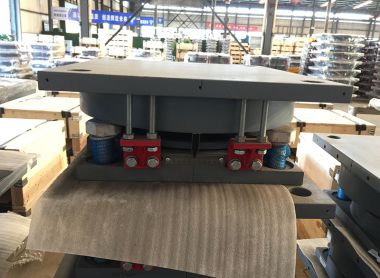
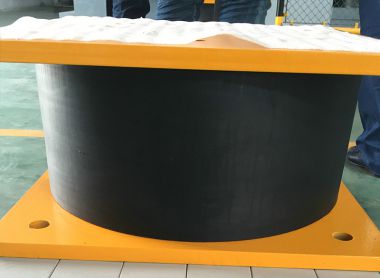
A lead rubber bearing is more than a simple support. It is a highly engineered seismic isolation device that combines vertical load capacity, horizontal flexibility, and energy dissipation. Whether used as a building seismic isolation bearing or a bridge seismic bearing, it determines whether a structure can survive strong ground motion without collapse — and often without major damage.
But how do engineers know a bearing will perform when it matters? The answer lies in performance-based design, limit states, and one critical test: the compression ultimate test.
1. The Shift to Performance-Based Design and 100-Year Service Life
Modern bridge and building codes have moved away from prescriptive rules. Instead of simply specifying dimensions and materials, they now define performance objectives. This shift is especially clear in Japan’s revised bridge design specifications, which introduced several key changes:
- 100-year design service life
New bridges are expected to remain safe and functional for a century. This demands not only strength, but also durability, maintainability, and long-term reliability.
- Partial factor design method
Load combinations over the entire 100-year period are re-evaluated. For new structural components and materials, reliability is assessed based on data — not assumptions.
- Limit state design method
Different bridge forms, structures, and materials must satisfy clearly defined limit states. This gives engineers a transparent framework to evaluate safety, serviceability, and durability.
- Durability and maintenance requirements
Design must align with maintenance strategies. A bridge seismic bearing or building seismic isolation bearing that cannot be inspected, replaced, or maintained will not meet modern life-cycle requirements.
In short, the question is no longer “Is it strong enough?” but “Will it perform reliably for 100 years?”
2. The Three Core Functions of a Seismic Isolation Bearing
Every seismic isolation bearing must fulfill three essential functions:
2.1 Force Transmission
The bearing transfers vertical loads from the superstructure to the substructure. It also handles horizontal forces such as braking, wind, and seismic actions. A lead rubber bearing must remain stable under combined vertical and horizontal loads.
2.2 Damping and Energy Dissipation
During an earthquake, the bearing must absorb and dissipate seismic energy. The lead core inside a lead rubber bearing yields and converts kinetic energy into heat, reducing the energy transmitted to the structure.
2.3 Displacement Follow-Up
Bridges expand and contract due to temperature changes. Traffic loads cause deflection. A bridge seismic bearing must allow controlled movement while maintaining load-carrying capacity. A building seismic isolation bearing must do the same for buildings, accommodating large horizontal displacement without failure.
These three functions — force transmission, damping, and displacement follow-up — form the foundation of reliable seismic isolation.
3. Understanding Boundary States: 1, 2, and 3
Modern bearing design uses limit state concepts to define acceptable performance under increasing load and displacement.
- Boundary State 1 (Limit State 1):
Behavior is reversible. The bearing remains within its elastic range, and load-carrying capacity is guaranteed within the expected range. No permanent deformation occurs.
- Boundary State 2:
Behavior loses reversibility. Partial load-carrying capacity may decline, but remains within a preset safe range. The structure enters a “non-fatal” state. It may need repair, but collapse is prevented.
- Boundary State 3:
Behavior becomes irreversible. Strength is not completely lost, but the bearing may no longer meet expected performance. This is the ultimate safety limit.
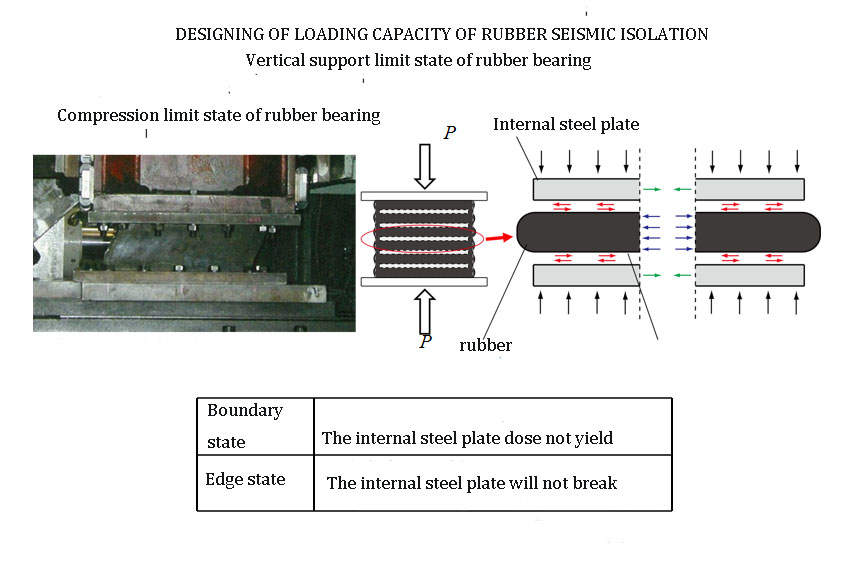
For a laminated rubber bearing or lead rubber bearing, the vertical support limit state is especially important. The internal steel plates must not yield, rupture, or cause buckling under compression. If the internal steel plates yield, the bearing may still function — but its long-term reliability is compromised. If they rupture, vertical support may fail.
This is why compression ultimate tests are essential for validating any building seismic isolation bearing or bridge seismic bearing.
4. Compression Ultimate Test: The Real Proof for Lead Rubber Bearings
Compression ultimate tests evaluate the vertical support performance of rubber bearings. They typically compare:
- Laminated rubber bearings without lead cores
- Lead rubber bearings with lead cores
Key observations from such tests include:
- Internal steel plates of laminated rubber bearings may yield at a certain load level.
- Lead rubber bearings provide higher damping, but the lead core also influences the yield behavior of internal steel plates.
- Buckling of the rubber support must be avoided.
- The bearing must maintain vertical load capacity even after repeated cycles.
For engineers, the compression ultimate test is not just a laboratory exercise. It is a critical validation step that determines whether a seismic isolation bearing can safely support a bridge deck or a building for decades.
A high-quality lead rubber bearing should be designed so that:
- Internal steel plates remain stable under design loads.
- Rubber layers are bonded reliably to steel plates.
- The lead core provides stable energy dissipation without premature failure.
- The bearing can accommodate large shear deformation without buckling.
These factors directly affect the safety of building seismic isolation bearings and bridge seismic bearings in real earthquakes.
5. Why This Matters for Buildings and Bridges
A lead rubber bearing is versatile. It can be used as:
- A building seismic isolation bearing for hospitals, schools, data centers, residential towers, and critical facilities.
- A bridge seismic bearing for highway bridges, railway bridges, viaducts, and sea-crossing bridges.
Compared with conventional bearings, lead rubber bearings offer:
- High energy dissipation capacity
- Stable hysteresis behavior
- Large horizontal displacement capacity
- Reliable vertical load support
- Long service life when properly designed and manufactured
For projects in high-seismic regions, specifying the right seismic isolation bearing is not a luxury — it is a fundamental safety decision.
6. Choosing the Right Seismic Isolation Bearing Supplier
If you are designing or upgrading a bridge or building in an earthquake-prone region, consider the following:
1. Define performance objectives — What level of earthquake should the structure withstand? What damage is acceptable?
2. Evaluate limit states — How will the bearing behave at Boundary State 1, 2, and 3?
3. Verify vertical support — Has the bearing passed compression ultimate tests?
4. Check displacement capacity — Can it accommodate thermal movement and seismic displacement?
5. Plan for maintenance — Can the bearing be inspected and replaced if needed?
At Yongxi Industrial Co..LTD, we supply high-performance lead rubber bearings, building seismic isolation bearings, and bridge seismic bearings designed for 100-year infrastructure. Our technical team can assist with selection, finite element analysis, and project-specific customization.